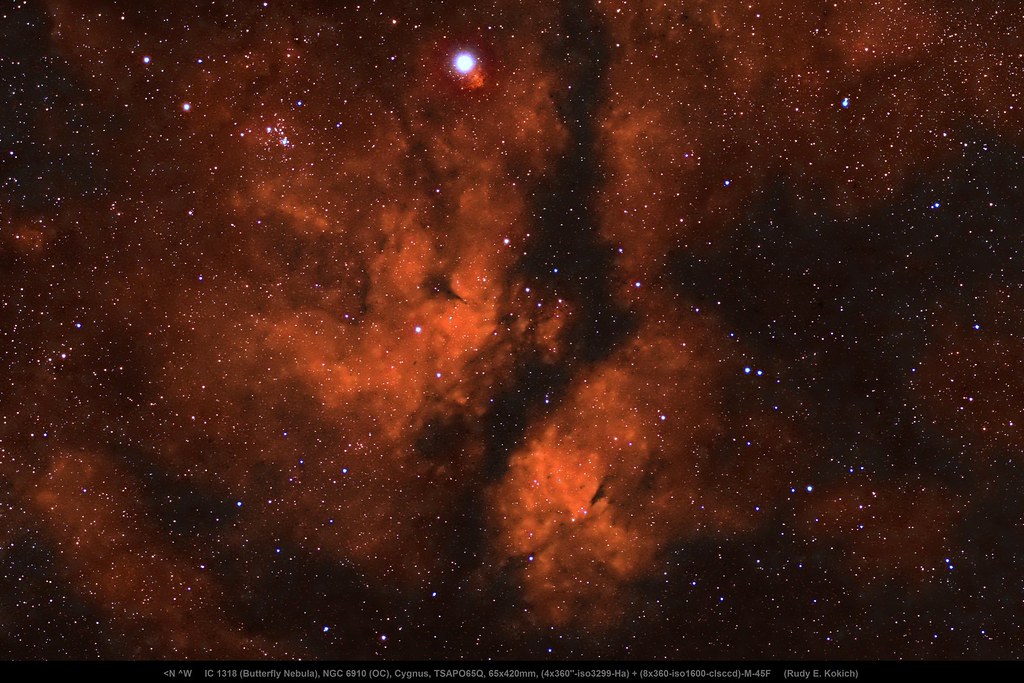
A Supergiant at Cygnus’ Center (Image Credits: Flickr)
The constellation Cygnus showcases the supergiant star Sadr enveloped by expansive regions of ionized gas and obscuring dust filaments.[1][2]
A Supergiant at Cygnus’ Center
Sadr, also known as Gamma Cygni, commands attention as one of the brightest stars in Cygnus with an apparent magnitude of 2.23.[3][4] This yellow-white supergiant occupies the central position in the Northern Cross asterism, making it a prominent naked-eye object during summer evenings in the Northern Hemisphere.[5]
Astronomers estimate Sadr’s distance at approximately 1,800 light-years from Earth.[6][3] Its absolute magnitude reaches -4.54, underscoring its immense luminosity despite the veil of interstellar material in its vicinity.[6] Positioned along the Milky Way’s rich star fields, Sadr highlights Cygnus as a prime region for studying stellar evolution and galactic structure.
Dark Intruders Amid Bright Emissions
Prominent dark nebula LDN 889 stands out by dividing two bright emission nebulae, LBN 245 and LBN 249, creating a striking contrast in the Sadr region.[1] These structures form part of the larger Gamma Cygni Nebula complex, cataloged as IC 1318, which spans several degrees across the sky.[2][7]
Lynds Bright Nebulae LBN 245 and LBN 249 glow from hydrogen ionized by nearby hot stars, while LDN 889’s dense dust blocks background light, forming tendrils that weave through the scene.[1] This interplay reveals ongoing processes in the interstellar medium, where gas clouds collapse to birth new stars.
- LDN 889: A prominent dark nebula interrupting bright emissions.
- LBN 245: Emission nebula positioned at the far edge of the field.
- LBN 249: Central bright nebula bisected by dust lanes.
- IC 1318: Overarching complex encompassing the Sadr region.[2]
- Gamma Cygni Nebula: Alternative name for the diffuse emissions around Sadr.[7]
Amateur Astrophotography Reveals Details
Oleg Bouevitch, an astrophotographer from Nepean, Ontario, Canada, imaged this intricate area using a 10-inch f/4.6 telescope.[1] He combined narrowband exposures totaling 25 hours: 3 hours in Hα, 13 hours in OIII, and 9 hours in SII filters to highlight the glowing gases.[1]
Such dedication uncovers faint structures invisible to the eye. The resulting composition, featured on Astronomy.com’s Picture of the Day, demonstrates how accessible equipment can probe deep-sky wonders.[1]
Cygnus as a Stellar Laboratory
Cygnus stretches across the Milky Way’s plane, offering views into dense star-forming zones. Sadr’s location places it foreground to these nebulae, though its light illuminates the gases without direct association.[8]
Observers often target this area for its mix of bright stars and subtle glows. From dark sites, binoculars reveal hazy patches around Sadr, inviting deeper exploration with telescopes.
Key Takeaways
This captivating Sadr region reminds skywatchers of the universe’s layered beauty, where stars and nebulae dance in eternal interplay. What strikes you most about Cygnus’ treasures? Tell us in the comments.