

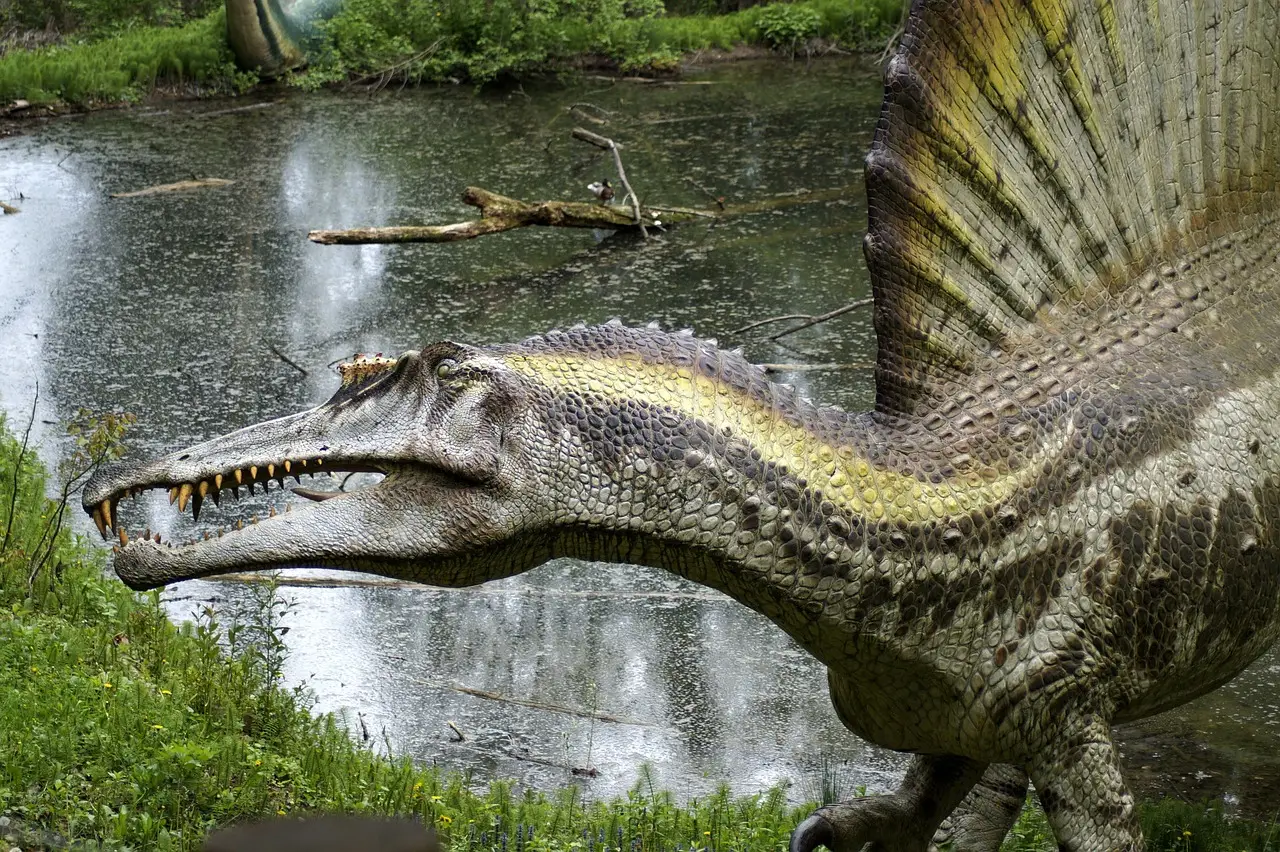
A Bone-Chilling Find in Remote Dunes (Image Credits: Pixabay)
Niger’s central Sahara concealed a predator from 95 million years ago until paleontologists unearthed its astonishing remains.[1][2]
A Bone-Chilling Find in Remote Dunes
Researchers first spotted fragments of an enormous cranial crest protruding from the sand at Jenguebi, a fossil-rich site deep in Niger’s desert, during a 2019 expedition. The team, led by University of Chicago paleontologist Paul Sereno, returned in 2022 with a larger group and recovered additional crests, jaw bones, teeth, and vertebrae. Local guides, including Tuareg nomads, directed them to this untouched area, hundreds of miles from ancient shorelines. The discovery marked the first new Spinosaurus species identified in over a century.[3]
Sereno described the moment of revelation. “The scimitar-shaped crest of Spinosaurus mirabilis was so large and unexpected that we initially didn’t recognize it for what it was,” he noted. Fossils came from the Farak Formation, a Cenomanian river deposit filled with fish and long-necked dinosaur remains. The haul included multiple specimens, confirming a distinct species named for its “astonishing” traits.[4]
Blade-Like Crest Defines a Predator
Spinosaurus mirabilis stood out with its massive, upward-curving nasal-prefrontal crest, resembling a scimitar sword up to a foot long. Scientists believe keratin sheathed the bone, extending its height and adding vibrant colors for display – perhaps to attract mates or intimidate rivals, much like a cassowary’s casque. The crest featured vascular canals and striations, supporting this interpretation. Interlocking teeth in its long, narrow snout formed a trap perfect for snaring slippery prey.[5]
Holotype fossils suggest a subadult around 8 meters long, comparable to a school bus, though adults likely grew larger. Sturdy hind legs allowed wading in up to two meters of water without floating. A possible back sail arose from elongated neural spines, though its full shape remains unknown.[1]
Fish Hunter of Ancient Rivers
This dinosaur thrived in forested inland wetlands crisscrossed by rivers, far from coasts – challenging views of spinosaurids as purely marine dwellers. It stalked shallow waters like a heron, targeting giant fish such as 3-meter coelacanths. “I envision this dinosaur as a kind of ‘hell heron’ that had no problem wading… but probably spent most of its time stalking shallower traps,” Sereno explained.[2]
Unlike diving swimmers, it avoided deep water, relying on its height and bite. The fluvial habitat yielded fish bones nearby, reinforcing its piscivorous diet. Proportional differences, like a more arched premaxilla and spaced rear teeth, set it apart from kin.[4]
| Feature | Spinosaurus mirabilis | Spinosaurus aegyptiacus |
|---|---|---|
| Crest Shape | Scimitar-like, posterodorsally curving | Smaller, less pronounced |
| Habitat | Inland rivers | Often coastal |
| Snout Teeth | Greater rear spacing | Tighter spacing |
Reshaping Spinosaur Evolution
The find, detailed in a February 19 Science paper, caps a 50-million-year spinosaur radiation. It highlights stepwise species emergence across Africa. Earlier relatives like Baryonyx preceded it, but S. mirabilis represents one of the last survivors. Experts like David Hone praised the crest’s scale but called for more complete skeletons.[3]
Such discoveries underscore Niger’s paleontological wealth and the value of local partnerships. Teams used 3D scanning in the field to assemble digital skulls, advancing analysis.
Key Takeaways
- First new Spinosaurus species in 100+ years, from Niger’s Sahara.
- Scimitar crest likely served display functions with bright colors.
- Semi-aquatic fisher in rivers, dubbed ‘hell heron’ for heron-like hunting.
Spinosaurus mirabilis reveals how these giants adapted to freshwater realms, enriching our view of Cretaceous life. What surprises might the Sahara yield next? Share your thoughts in the comments.