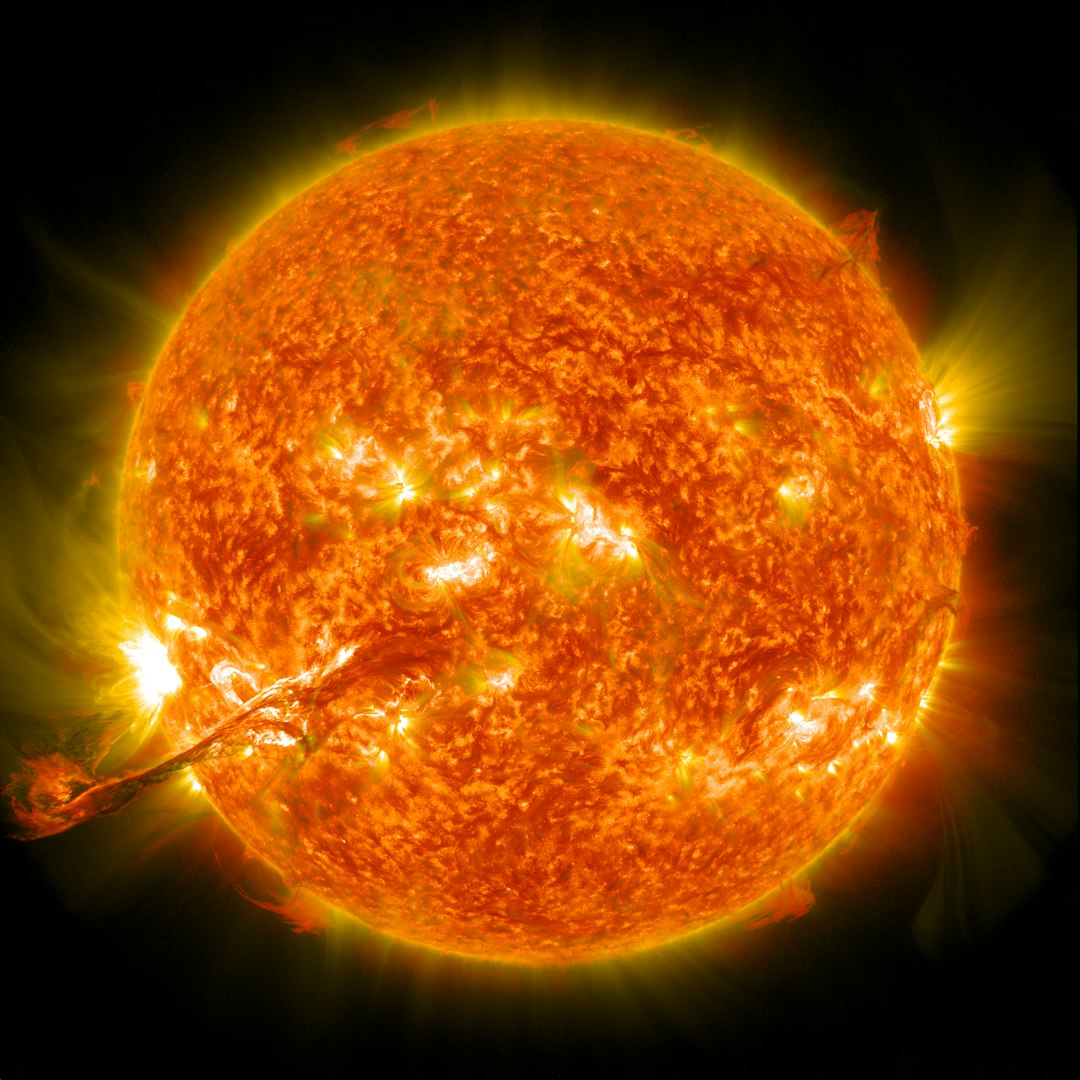
AR4403’s Flare Burst and Rapid Decline (Image Credits: Unsplash)
Solar activity entered a transitional phase on March 27, 2026, following a burst of flares the day before. The prominent active region AR4403, recently rotated into Earth’s view, subsided after producing an M3.9-class solar flare. At the same time, new sunspot groups appeared on the Sun’s eastern horizon, signaling potential future developments. Space weather forecasters also eyed a faint coronal mass ejection that could deliver a glancing impact to our planet by March 29.[1][2]
AR4403’s Flare Burst and Rapid Decline
The M3.9 flare from AR4403 peaked at 6:11 UTC on March 26, marking the region’s dramatic debut on the solar disk.[2] This event triggered an R1 minor radio blackout over the Indian Ocean region, disrupting high-frequency communications briefly. AR4403 had already shown its potential with multiple C-class flares in the preceding hours, including C2.1, C2.2, and C1.7 events.[2]
By March 27, activity from this northeast quadrant sunspot group diminished noticeably. Observers tracked its evolution through images from NASA’s Solar Dynamics Observatory, which captured the region’s explosive behavior against a backdrop of brighter plasma and a nearby coronal hole. The quick calming suggested a temporary lull, though experts continued to monitor it closely given its recent vigor.[2]
New Active Regions Rolling into View
Fresh sunspot formations began rotating onto the visible solar disk from the east limb on March 27. Reports highlighted AR4404 and AR4406 in the northeast quadrant alongside the settling AR4403, while AR4405 joined AR4399 in the southeast quadrant.[3] These newcomers added to the tally of active regions, which stood at seven on the Earth-facing side the previous day.
Such rotations are routine as the Sun completes one turn every 27 days from our perspective. However, the arrival of multiple groups raised interest among solar watchers. Ground-based observations from sites like the Udaipur Solar Observatory labeled these features clearly, revealing a dynamic solar surface with evolving magnetic complexities.[2]
Glancing CME Threat and Space Weather Outlook
A faint coronal mass ejection drew attention for its possible grazing path near Earth on March 29. This development followed earlier CME arrivals, including one on March 25 that sparked a G1 minor geomagnetic storm. No major Earth-directed ejections occurred in the immediate 24 hours prior to March 27, but the subtle event warranted tracking.[1][2]
Forecasts predicted unsettled to active geomagnetic conditions around March 28-29, potentially from a high-speed solar wind stream out of a coronal hole. Auroral displays remained possible at high latitudes, such as northern Scotland, Iceland, and Scandinavia, if southward interplanetary magnetic field components aligned. Overall solar flare probabilities stayed low, with a 30% chance for additional M-class events.[2]
Context Within Solar Cycle 25
The Sun’s behavior fit patterns of Solar Cycle 25, which has produced escalating activity through early 2026. Moderate-to-high flare levels marked the March 25-26 period, with eight events including the standout M3.9. Active regions like AR4399 and AR4401 carried complex magnetic configurations capable of stronger outbursts, though none escalated further by March 27.
- AR4403: Primary flare producer, now calming.
- AR4401: Beta-gamma class, monitored for flares.
- AR4399: Beta-delta potential, quiet recently.
- New entrants: AR4404, AR4405, AR4406 adding spots.
Solar wind speeds and densities fluctuated under recent CME influences, with the interplanetary magnetic field showing variable Bz orientations. These factors drove minor storms earlier in the week, visible as auroras even at mid-latitudes like New York and London on March 22-23.[2]
Key Takeaways:
- AR4403 calmed post-M3.9 flare, reducing immediate flare risk.
- New regions AR4404, 4405, 4406 rotated in, boosting sunspot count.
- Faint CME may graze Earth March 29, with minor geomagnetic effects possible.
As the Sun continues its rotation, these changes underscore the dynamic nature of space weather. Skywatchers and satellite operators alike prepare for what the coming days might bring. What solar surprises await? Share your thoughts and observations in the comments.