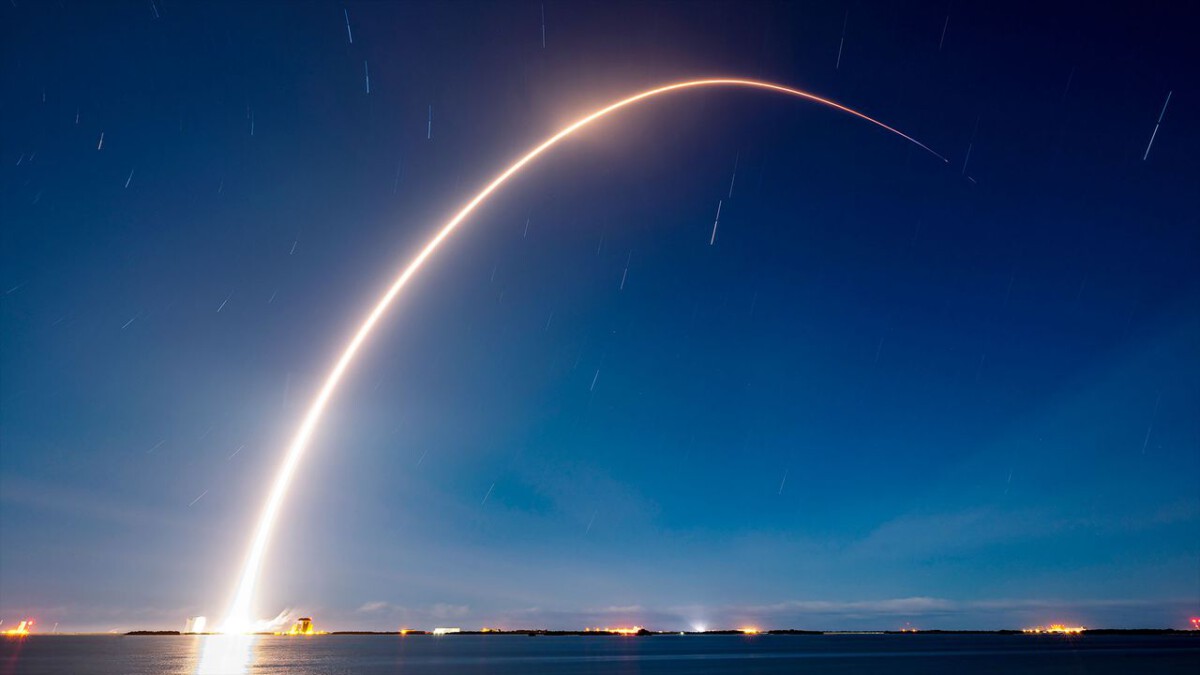
Veteran Booster Powers West Coast Liftoff (Image Credits: Cdn.mos.cms.futurecdn.net)
SpaceX expanded its Starlink broadband network with consecutive Falcon 9 launches from California and Florida on January 29 and 30, 2026.[1]
Veteran Booster Powers West Coast Liftoff
First-stage booster B1082 marked its 19th flight when it lifted off from Space Launch Complex 4 East at Vandenberg Space Force Base in California on January 29.[1] The rocket carried 25 satellites designated for Starlink Group 17-19. Minutes after ascent, the booster separated and executed a precise landing on the droneship Of Course I Still Love You stationed in the Pacific Ocean.
This mission highlighted SpaceX’s operational tempo early in 2026. The deployment added critical capacity to the low-Earth orbit constellation. All satellites reached their planned trajectories successfully.[1]
Florida Mission Completes the Doubleheader
Less than 24 hours later, another Falcon 9 rocketed skyward from Space Launch Complex 40 at Cape Canaveral Space Force Station. Liftoff occurred at 2:22 a.m. EDT (0722 GMT) on January 30. Booster B1095, on its fifth flight, hauled 29 Starlink satellites from Group 6-101.[1]
The first stage returned to sea, touching down on the droneship Just Read the Instructions in the Atlantic Ocean. Deployment followed nominal separation, pushing the network’s growth forward. These efforts marked SpaceX’s 13th launch of the year and the 596th overall Falcon 9 mission since 2010.[1]
Launch Comparison at a Glance
| Date | Location | Satellites | Booster (Flights) | Landing Vessel |
|---|---|---|---|---|
| Jan. 29, 2026 | Vandenberg SFB, CA (SLC-4E) | 25 (Group 17-19) | B1082 (19th) | Of Course I Still Love You |
| Jan. 30, 2026 | Cape Canaveral SFS, FL (SLC-40) | 29 (Group 6-101) | B1095 (5th) | Just Read the Instructions |
Both operations unfolded flawlessly, underscoring reusable rocket reliability.
Starlink Constellation Surges Past 9,600 Satellites
The pair of missions boosted the active Starlink fleet beyond 9,600 satellites, according to independent tracker Jonathan McDowell.[1] This rapid addition supports global broadband access in underserved regions. Starlink now powers in-flight WiFi for select airlines and enables direct satellite-to-cell service on certain carriers.
- Enhances internet for remote communities worldwide.
- Facilitates connectivity during disasters or travel.
- Expands capacity for high-speed data transmission.
- Integrates with mobile networks for texting and calls.
SpaceX continues frequent deployments to maintain dense coverage. For full details, see the Space.com report.[1]
Key Takeaways
- 54 satellites deployed in under 48 hours across coasts.
- Boosters B1082 and B1095 achieved pinpoint ocean recoveries.
- Starlink fleet exceeds 9,600, advancing global internet equity.
SpaceX’s back-to-back successes demonstrate unmatched launch cadence and hardware durability. As the constellation densifies, reliable high-speed internet edges closer for millions. What do you think of this dual-coast strategy? Tell us in the comments.