

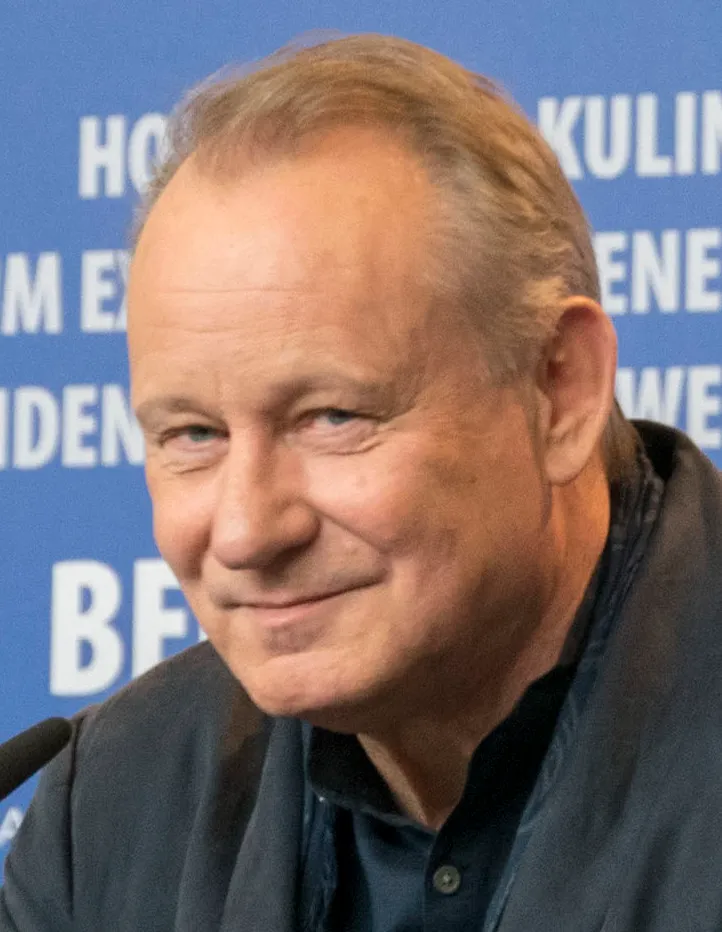
Navigating Family Tensions on Screen (Image Credits: Upload.wikimedia.org)
Swedish actor Stellan Skarsgård offered a thoughtful perspective on human nature during a recent NPR interview, tying it to his acclaimed performance in the family drama Sentimental Value.[1]
Navigating Family Tensions on Screen
Skarsgård portrayed Gustav Borg, a once-celebrated filmmaker who reconnects with his estranged daughters Nora and Agnes after their mother’s funeral. Directed by Joachim Trier, the 2025 release examined the blurred lines between art and personal life as Gustav cast a young Hollywood star in a role meant for Nora.[2][3] Critics praised the film’s mature handling of resentment and reconciliation, earning it a 97% Tomatometer score on Rotten Tomatoes.[3]
His character embodied generational conflicts, prioritizing career over emotional bonds. Skarsgård delivered a restrained performance that captured micro-aggressions through subtle body language and tone. The role earned him a 2026 Oscar nomination for best supporting actor.[1][4]
Real-Life Parallels as Father of Eight
Skarsgård drew from his own experiences raising eight children, several of whom followed him into acting, including Bill and Alexander. He recognized universal struggles in Gustav’s story, noting the difficulty artists face balancing work and family. One son even pointed out similarities, despite Skarsgård’s insistence that Gustav represented a different generation.[1]
“What became clear to me is, I have eight children,” Skarsgård reflected. “Some children need me a lot, and some don’t need me at all. So you can’t get it right as a parent.”[1] Four years before filming, a mild stroke challenged his memory and balance, yet he managed scenes using an earpiece prompter without visible impact.
Rejecting Simple Villains in Acting and Life
Despite villainous roles like Dune’s Baron Harkonnen, Skarsgård dismissed binary views of people. “They’re flawed, they’re sad, and they’re comic,” he said. “They are everything.”[1] This philosophy shaped his approach to complex characters across over 100 films.
Early highlights included improvising with Robin Williams in Good Will Hunting, where spontaneity created vivid takes. He also overcame fears to sing and dance in the Mamma Mia! musicals, supported by ABBA’s Björn Ulvaeus and Benny Andersson. Skarsgård viewed acting as intuitive, not intellectual: performers must evoke real, spontaneous emotions like amateurs.[1]
A Legacy of Family and Nuance
Skarsgård avoided guiding his children’s careers, preferring shared gossip over advice at family dinners. The film’s themes resonated broadly, as Roger Ebert’s review hailed his work as “never better,” emphasizing authentic family rebuilding.[4]
- Over 100 films since his teens.
- Father to actors Bill, Alexander, and others.
- Oscar-nominated for Sentimental Value.
- Stroke recovery enabled prompter use on set.
- Philosophy: Humans defy “bad guy” labels.
Key Takeaways
- Skarsgård sees no pure villains – only multifaceted people.
- His role mirrored real fatherhood challenges.
- Acting thrives on instinct, not analysis.
Stellan Skarsgård’s insights remind us that family stories, like life, resist easy judgments. What do you think about his view on human complexity? Tell us in the comments.