
You spend an hour crafting the perfect cover letter. You tailor your resume, triple-check your LinkedIn, and hit “Apply” with a knot of cautious optimism in your stomach. Then nothing. A week passes. Then a month. The silence is deafening. Here’s the unsettling truth: that job may never have existed at all.
Ghost jobs – listings posted online with no genuine intention of hiring anyone – have quietly become one of the most damaging forces in today’s labor market. They inflate hope, drain energy, and skew the very data economists use to understand employment. The scale of this problem is far bigger than most people realize. Let’s dive in.
The Numbers That Should Make You Angry

Roughly four in ten companies said they posted a fake job listing in the span of a single year, according to a May 2024 survey of 650 hiring managers from career site Resume Builder. That is not a rounding error. That is nearly half the corporate world admitting, on record, to deceiving job seekers.
Three in ten companies currently have fake listings sitting live on their sites or on public job boards right now. Scroll through LinkedIn or Indeed on any given day, and statistically, a significant chunk of what you see is a mirage. A separate analysis found that roughly 27 out of every 100 U.S. job listings on LinkedIn are likely ghost jobs with no real intention to hire.
What Exactly Is a Ghost Job?

According to the Congressional Research Service, the term is defined as “online job postings for positions that do not exist, or that employers are not planning to fill immediately.” Notice the word “immediately” in there – it’s doing a lot of heavy lifting. A company can post a role, interview candidates, and still have no plans to make an offer anytime soon.
Unlike job scams in which criminals seek to obtain applicants’ personal information, hiring managers themselves are often behind these ghost jobs. That’s what makes them so insidious. These are legitimate organizations, not shadowy fraudsters. Legitimate companies are increasingly posting fake job listings, often referred to as ghost jobs. It’s a betrayal hiding in plain sight.
Why Do Companies Actually Do This?

Companies posted fake job listings to make it appear the company is open to external talent, to act like the company is growing, to make employees believe their workload would be alleviated by new workers, to have employees feel replaceable, and to collect resumes and keep them on file for a later date. Honestly, that list reads like a corporate manipulation playbook.
Some employers post ghost jobs specifically to make current employees feel replaceable, hoping it will motivate them to work harder. As many as 68% of recruiters surveyed claimed fake job postings have a “positive impact on revenue,” and 77% noticed an increase in employee productivity when ghost jobs were listed. Let that sink in. Psychological pressure on existing staff – manufactured through fake ads – is being framed as a business strategy.
The Hiring Freeze Factor Nobody Talks About

A role gets approved in Q1 budgeting. The hiring manager posts it. Then a spending freeze hits in Q2. The listing stays up because nobody bothers to take it down. This scenario, repeated across thousands of companies, quietly floods job boards with stale, inactive listings that look perfectly real from the outside.
Workforce intelligence company Revelio Labs found that the rate of hires per job posting has essentially halved over the past five years. In 2019, there were eight hires for every ten job postings. By 2024, that number had dropped to just four hires per ten job postings. That collapse in the hire-to-posting ratio is one of the clearest signals that the job market is increasingly polluted with ghost listings.
The Sectors Hit Hardest
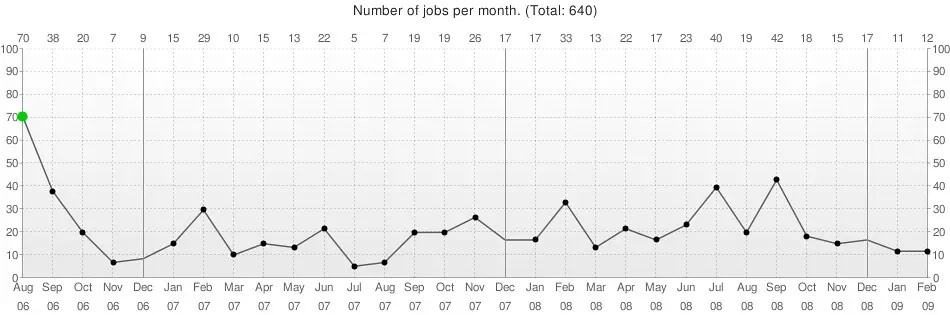
The tech sector is particularly notorious because specialized roles like AI engineers, data scientists, and software developers require niche skills, so companies keep ads open indefinitely to scout talent. But tech is far from alone in this. The construction industry leads the ghost job rankings with some of the highest rates of postings that never result in hires, while arts and entertainment, food and beverage services, and legal services follow close behind. Corporate services jobs showed a ghost job rate of nearly 31% in the second quarter of 2024, meaning almost one in three corporate job postings resulted in no hires.
In highly specialized sectors like engineering, architecture, construction, and manufacturing, ghost jobs cause even greater disruption. Roles often require licenses or niche technical skills, meaning candidates spend more time and resources preparing. According to Greenhouse, the construction industry showed ghost job rates as high as 38%. Imagine spending weeks studying for technical certifications only to apply for a job that was never going to be filled. That’s not hypothetical. That’s happening to real people right now.
The Real Cost: Burnout, Silence, and Shattered Confidence

About two-thirds of job seekers are experiencing burnout from their search, according to a 2025 Employ Inc. report. Ghost jobs are a core driver of that exhaustion. More than half of job seekers experienced ghosting by employers within the last year, according to a report from pre-employment testing company Criteria. That number reached a three-year peak as 48% of applicants were ignored by employers in 2025.
According to LiveCareer’s 2025 Job Search Frustration report, 57% of job seekers admitted to abandoning an application mid-process due to overly complicated or time-consuming requirements, while 41% believed fewer than a quarter of their job applications were ever seen by a real person. It’s a demoralizing loop: apply, wait, hear nothing, repeat. Repeated exposure to ghost jobs contributes to job search fatigue, emotional burnout, and declining confidence in the process, while also distorting market signals and misleading job seekers into making decisions about relocation, education, or career shifts.
How Ghost Jobs Are Warping Labor Market Data

Since the beginning of 2024, job openings have outnumbered hires by more than 2.2 million a month, according to Bureau of Labor Statistics data – a gap that points directly to ghost jobs that never seem to get filled. This is more than an inconvenience for job seekers. It’s a systemic data problem with real policy consequences.
Federal Reserve officials watch Bureau of Labor Statistics job openings numbers closely for clues about how tight the labor market is, so having unreliable data clouds their vision. Think about that for a moment. Interest rate decisions, fiscal policy, unemployment interventions – all shaped by numbers inflated by jobs that don’t actually exist. Subtract ghost jobs, and the real ratio of jobs to job seekers falls closer to 0.77 to 0.85, meaning for every 100 job seekers, there may be only roughly 77 to 85 real openings.
Governments Are Starting to Fight Back

The proposed 2025 Truth in Job Advertising and Accountability Act would require employers to disclose their intent to hire, include salary bands, and set deadlines for removing stale posts. It would grant enforcement power to the Department of Labor and the FTC, and even provide legal recourse for affected job seekers. It’s a bold step, though whether it will pass remains to be seen.
In Kentucky, a bill introduced in January 2025 would prohibit the posting of ghost jobs and require disclosure of whether a posting is for an existing vacancy or an anticipated future vacancy. In California, a bill introduced in March 2025 would require all private employers advertising job postings to include a clear, legible statement disclosing whether the posting is for a vacancy or not. On the platform side, LinkedIn and Greenhouse have introduced verification systems for job postings, with LinkedIn reporting that more than half its listings are now tagged as “verified,” indicating confirmed open positions.
How to Protect Yourself Right Now

If a listing has been posted and reposted for 30, 60, or 90 or more days, something is wrong. Either the company is not seriously hiring, the role has impossible requirements, or the budget disappeared. Think of it like a restaurant menu item with an asterisk that never goes away – at some point, you have to wonder if it was ever actually available. Time on a listing is your first and most reliable red flag.
To detect if a job listing is a ghost job, consider whether it has been posted for more than two months, whether the same position is repeatedly advertised, and whether the job title and description lack specific details about the actual role. Beyond that, reach out directly to a named recruiter or employee at the company on LinkedIn before pouring hours into a tailored application. A simple human connection can confirm in minutes what months of waiting cannot. A petition on Change.org seeking to clamp down on companies advertising ghost jobs has already garnered nearly 50,000 signatures – proof that frustrated job seekers are no longer willing to stay silent about this.
Conclusion

Ghost jobs are not a minor quirk of the digital hiring age. They are a large-scale structural problem – one that wastes human potential on a massive scale, distorts economic data that affects millions, and quietly erodes the trust that a functioning labor market absolutely depends on. The fact that it took formal congressional attention and proposed legislation to even begin addressing this tells you how normalized the practice had become.
The hopeful sign is that awareness is growing fast. Regulators are mobilizing, platforms are adding verification tools, and job seekers themselves are getting smarter about spotting the signs. Still, the burden shouldn’t fall on exhausted applicants to detective their way through a sea of fake listings. Companies that post ghost jobs know exactly what they’re doing – and the reckoning, legislative or reputational, appears to finally be on its way.
Have you ever suspected you applied for a ghost job? What would you like to see companies or platforms do differently? Share your thoughts in the comments.