

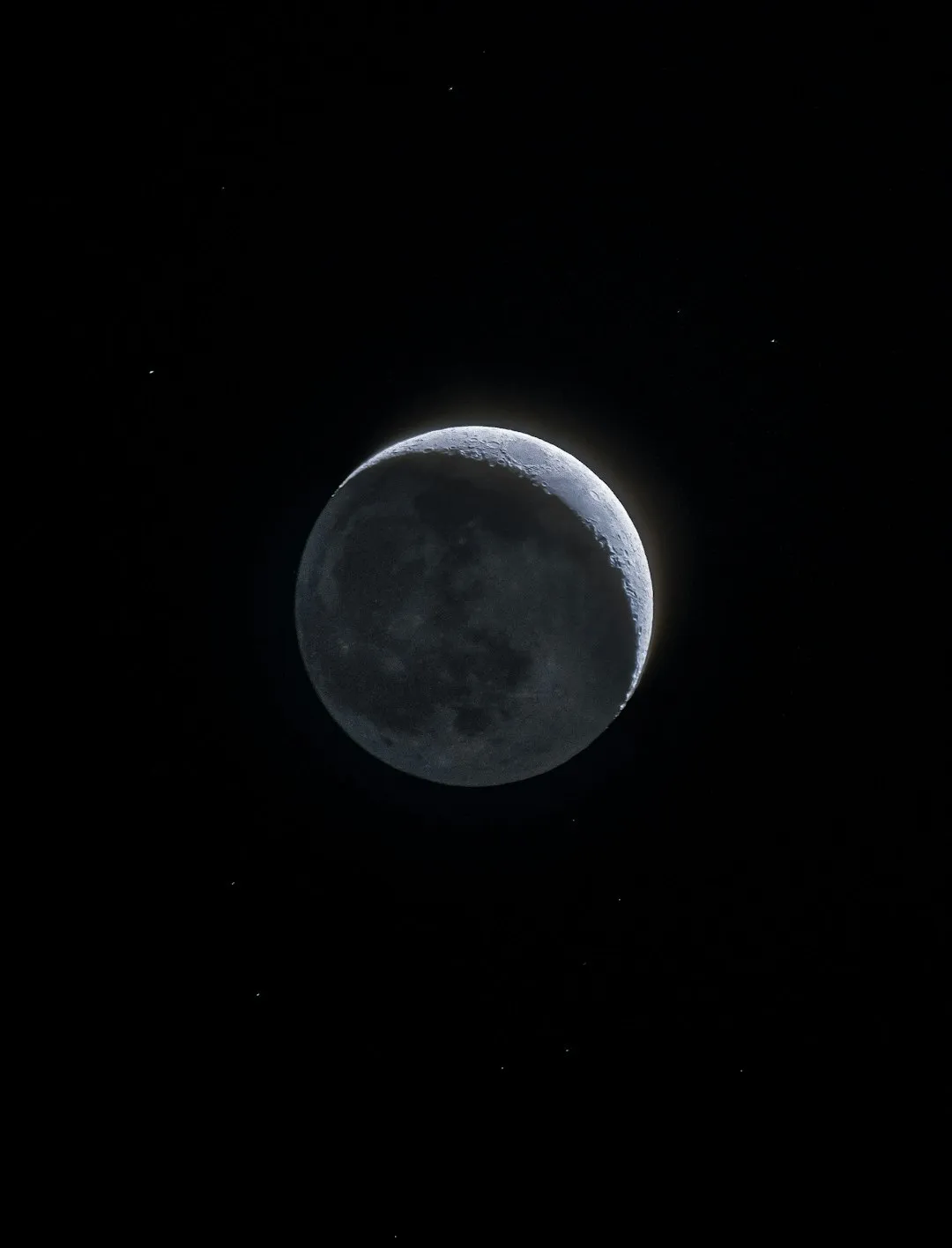
Ganymede Tops the List as the Largest Moon (Image Credits: Unsplash)
Among the hundreds of moons orbiting planets in our solar system, only two surpass the size of Mercury, the innermost planet.[1][2]
Ganymede Tops the List as the Largest Moon
Ganymede, one of Jupiter’s four major moons, holds the title of the solar system’s largest satellite. Its mean diameter measures 5,268 kilometers, exceeding Mercury’s 4,879 kilometers.[2][3]) Scientists discovered this icy world in 1610, and missions like Galileo provided detailed insights into its composition.
The moon features a grooved surface and a subsurface ocean, hinting at geological activity. Ganymede also possesses its own magnetic field, a rarity among moons. These traits set it apart from smaller satellites.
Titan Rivals Ganymede in Scale
Saturn’s Titan ranks second with a diameter of 5,150 kilometers, still larger than Mercury.[2][4]) Thick nitrogen-rich atmosphere obscures its surface from casual observation, but radar mapping revealed lakes of liquid methane.
The Cassini-Huygens mission landed the Huygens probe on Titan in 2005, capturing images of its rugged terrain. This hazy world stands as the only moon with a substantial atmosphere and stable surface liquids.
Close Contenders Fall Short
Callisto, another Jovian moon, comes closest at 4,821 kilometers across, just shy of Mercury’s girth.[2][5]) Heavily cratered and ancient, it lacks the internal heat of its siblings.
Earth’s Moon measures 3,474 kilometers, while Io and Europa trail further behind. No other satellites reach or exceed Mercury’s size threshold.
| Object | Diameter (km) | Parent Body |
|---|---|---|
| Mercury | 4,879 | Sun |
| Ganymede | 5,268 | Jupiter |
| Titan | 5,150 | Saturn |
| Callisto | 4,821 | Jupiter |
| Earth’s Moon | 3,474 | Earth |
What Makes These Moons So Large?
Jupiter and Saturn, gas giants with immense gravity, captured or formed these massive moons during the solar system’s early chaos. Their size suggests formation in protoplanetary disks rich in material.
Smaller planets like Mercury and Venus host no moons, while outer worlds boast dozens. Yet only these two achieved planet-like dimensions.
- Ganymede: Magnetic field and possible ocean.
- Titan: Organic chemistry and weather cycles.
- Callisto: Oldest intact surface.
- Implications for habitability research.
- Targets for future missions like Europa Clipper.
Key Takeaways
- Only Ganymede and Titan exceed Mercury’s diameter.
- Both orbit gas giants and show unique geology.
- These moons challenge definitions of planets versus satellites.
These oversized moons remind us of the solar system’s diverse scales and ongoing mysteries. Future explorations may uncover more about their origins and potential for life. What surprises you most about these cosmic giants? Share in the comments.