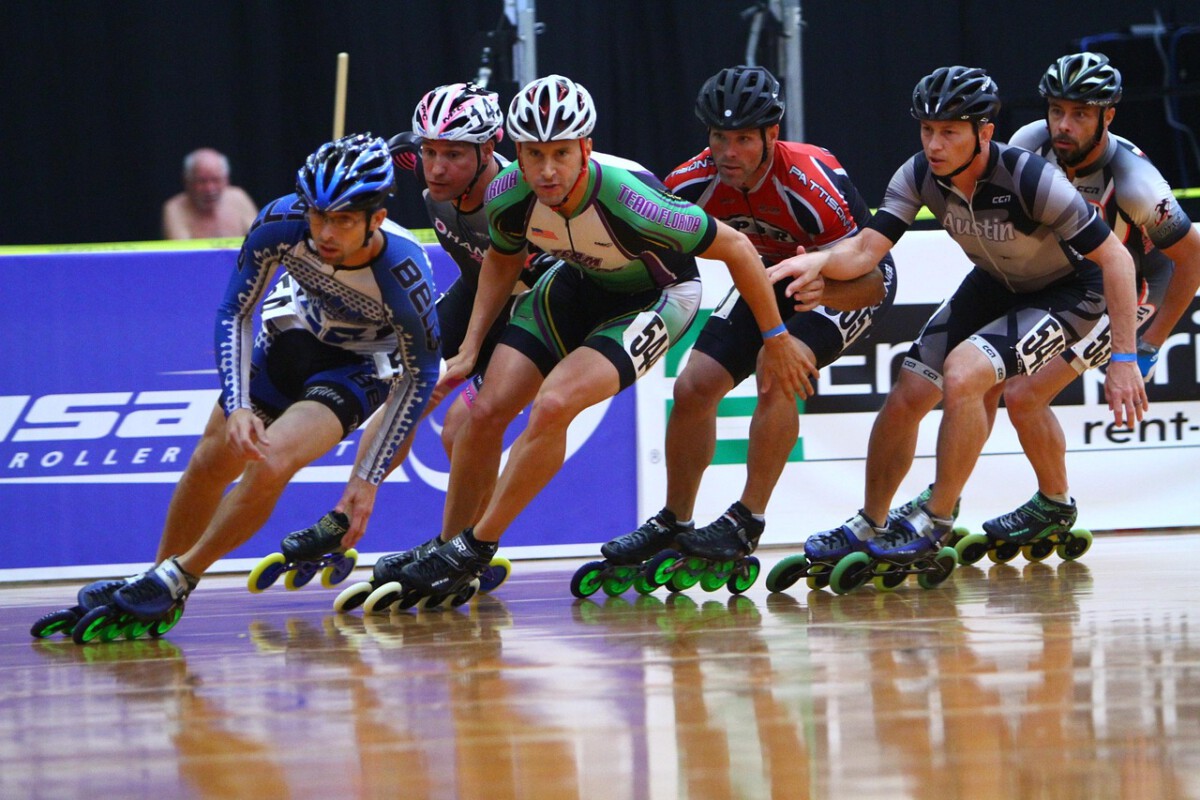
Pushing Limits at 30 MPH (Image Credits: Pixabay)
Milan – United States speed skaters have introduced a NASCAR-derived pushing method that promises to elevate their performance in the team pursuit competition during the final days of the 2026 Winter Olympics.[1]
Pushing Limits at 30 MPH
Competitors in the team pursuit event reach speeds approaching 30 miles per hour while maintaining positions mere inches apart on the 400-meter oval.[1] Three skaters per team complete six laps for women and eight for men, crouched low to minimize drag. Each athlete places a hand on the rear of the skater ahead, propelling the group forward in unison. U.S. skater Giorgia Birkeland described the proximity vividly: “You should be as close as humanly possible to the gluteus maximus.”[1]
This synchronization creates the illusion of a single unit gliding across the ice. Birkeland emphasized the demand for precision: “What you really should be seeing is only one skater. All lined up and then all pushing throughout the race.”[1] The approach demands complete trust, especially for the third skater who relies entirely on the leaders ahead.
Engineering Efficiency from Aerodynamics
Sports aerodynamicist Ingmar Jungnickel spearheaded the innovation ahead of the 2022 Beijing Olympics. His AI-powered simulation analyzed airflow and drag, revealing that physical pushing outperformed traditional drafting.[1] Jungnickel, drawing from cycling expertise, built a mathematical model tailored to indoor ice conditions. The results proved transformative: “Pushing is substantially faster. And in fact, so fast that you can go from eighth in the world to first in the world using this technique.”[1]
U.S. Speedskating chief Shane Domer commissioned the study after years of lackluster results in the event, which debuted at the Olympics in 2006. Coaches initially resisted the idea, fearing fatigue for leaders and collision risks on sharp blades. Yet data won them over, prompting a full training overhaul.
Training Precision Under Pressure
Athletes now specialize in fixed positions – first, second, or third – honing skills to stay aligned without clipping edges. Domer highlighted the challenge: “Not only are you looking to put power down on the ice to make yourself go forward fast, but to synchronize with each other, and to get so close to one another while not tripping over one another or clipping with one another is a skill that our athletes have worked very, very hard to perfect.”[1] Jungnickel compared the effort to “ballroom dancing with knives on your feet,” underscoring the razor-thin margins for error.
Birkeland, who occupies the third spot, stressed adaptability: “You have to read their body language. You have to get used to their skating style and their strokes. Trust is a huge thing.”[1] The women’s squad – Birkeland, Brittany Bowe, Mia Manganello, and Greta Myers – embodies this finesse.
Global Shift and Medal Prospects
Originally inspired by NASCAR’s “bump-drafting,” where cars nudge each other to share effort, the tactic defied speed skating conventions modeled after cycling or bird formations. The U.S. gained an early edge, but top teams adopted it by 2022, securing the podium spots. Domer predicted its dominance: “To be successful, most teams have to rely on this technique. I feel like you’re probably going to see most teams doing it in the Olympic Games.”[1]
- Women race six laps; men race eight.
- Skaters hit 30 mph in crouched formation.
- Hand-on-rear pushes minimize air resistance.
- Position specialization enhances sync.
- Sharp blades heighten fall risks.
Key Takeaways
- U.S. pioneered push technique via AI aerodynamics.
- Now the global standard for team pursuit.
- Trust and finesse drive success at elite speeds.
The U.S. team’s mastery of this high-stakes push positions them strongly for podium finishes in Milan, proving cross-sport ingenuity can redefine winter athletics. What innovations will you watch for next in the Olympics? Share your thoughts in the comments.