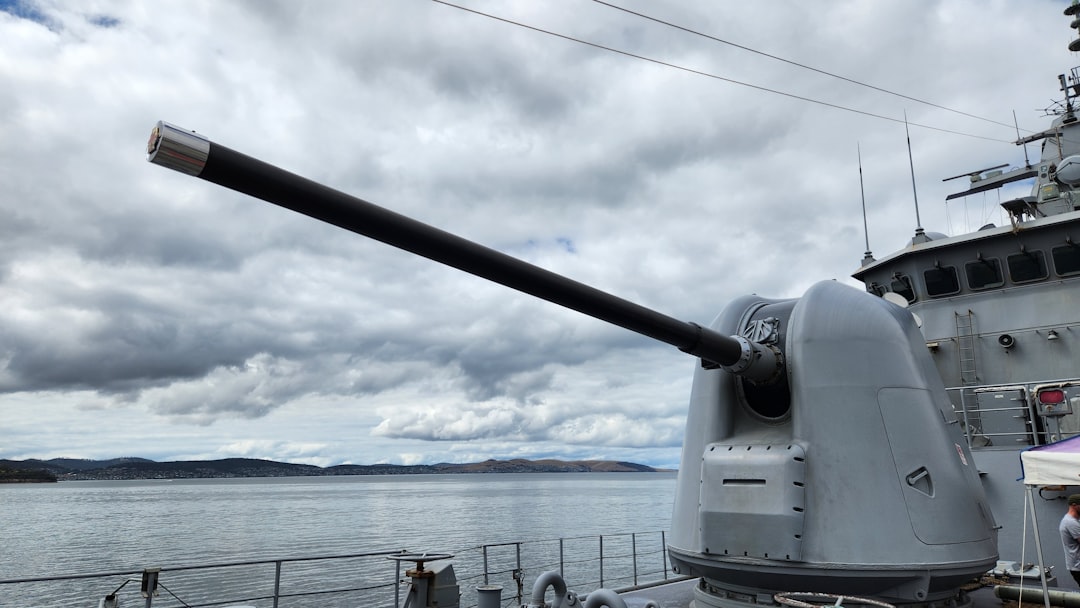
Origins and Early Successes of the SSL-TM (Image Credits: Unsplash)
Point Mugu, California – The U.S. Navy recently disclosed details of a significant effort to restore a powerful laser weapon system for use in a major military exercise. Engineers at the Directed Energy Systems Integration Laboratory spent months reactivating the 150-kilowatt Solid State Laser Technology Maturation demonstrator. This revival addressed urgent needs in countering aerial drones during the Crimson Dragon event.
Origins and Early Successes of the SSL-TM
The Solid State Laser Technology Maturation (SSL-TM) demonstrator, also known as the Laser Weapon System Demonstrator Mk 2 Mod 0, entered development in 2012. Naval researchers installed it on the USS Portland, a San Antonio-class amphibious transport dock, in 2019. This system succeeded the earlier 30-kilowatt AN/SEQ-3 Laser Weapon System, which had been tested on the USS Ponce in 2014.
Designed to tackle asymmetric threats such as drones and explosive-laden small boats, the SSL-TM proved effective in real-world tests. In May 2020, it destroyed a drone target during at-sea trials in the Gulf of Aden. Additional testing in December 2021 neutralized a small surface vessel, validating its potential for fleet integration.
Decommissioning and Swift Reactivation
Despite its successes and design compatibility with Arleigh Burke-class destroyers, the Navy removed the SSL-TM from the USS Portland in fiscal year 2023. The deinstallation followed nearly $50 million in investments, though a final Department of Defense report remains unpublished. Prime contractor Northrop Grumman had optimized the system for easy shipboard use.
The weapon system entered storage until the Office of the Under Secretary of Defense for Research and Engineering requested its involvement in the Crimson Dragon exercise in September of the following year. Starting in early March 2025, the DESIL team at Naval Base Ventura County ramped up restoration efforts. This one-of-a-kind 150-kilowatt laser returned to operational status within six months.
Performance in the Crimson Dragon Exercise
Crimson Dragon brought together 20 defense contractors for a weeklong simulation of combat scenarios. Participants tested drones, counter-drone technologies, and sensors in contexts like base defense, long-range fires, and ballistic missile defense. The exercise emphasized sea-based defenses against maritime air and sea threats, including protection for embarkation points.
The revived SSL-TM demonstrator excelled by shooting down four drone targets. Details on specific scenarios remain limited, but its role highlighted the value of high-energy lasers in integrated defenses. A recent Pentagon assessment confirmed the event’s focus on realistic threat environments.
Challenges in Scaling Directed Energy Weapons
The Navy’s reliance on this retired prototype underscores broader hurdles in directed energy programs. Few high-energy laser systems are available for large-scale training. For instance, the Army demilitarized its four 50-kilowatt DE M-SHORAD units, while its AMP-HEL lasers support border operations.
The Marine Corps returned Compact Laser Weapon Systems to Boeing, and Navy’s ODIN lasers serve on active ships. The 60-kilowatt HELIOS system faced its own setbacks. This scarcity forces militaries to repurpose prototypes, even those destined for museums, to advance tactics against proliferating drone threats.
- SSL-TM: Successfully downed drones in 2020 and 2021 tests; revived for 2025 exercise.
- DE M-SHORAD: Army’s 50kW systems now demilitarized.
- HELIOS: Navy’s 60kW laser encountered operational issues.
- CLaWS: Returned to manufacturer by Marines.
- ODIN: Deployed on warships for dazzling threats.
Key Takeaways
- Revived lasers fill gaps in counter-drone training amid limited prototypes.
- Crimson Dragon tested integrated defenses in simulated combat.
- SSL-TM’s return signals ongoing push for scalable directed energy solutions.
The U.S. military continues to invest in laser technologies to counter evolving threats, yet the Crimson Dragon revival reveals the gap between prototypes and widespread deployment. As drone warfare intensifies, such systems offer cost-effective defenses, but scaling remains critical. What do you think about the future of laser weapons in modern conflicts? Tell us in the comments.