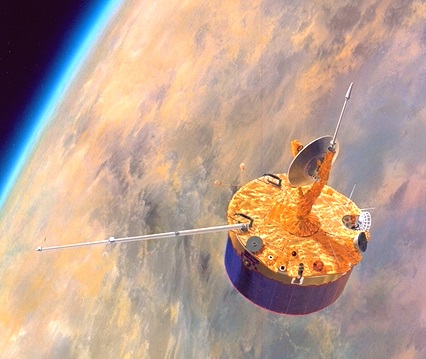
A Bold Trio Now in Doubt (Image Credits: Upload.wikimedia.org)
NASA’s plans for an exciting revival of Venus exploration confront serious budget hurdles. Officials warned that financial constraints could limit the agency to pursuing just one of three key missions during what was billed as a transformative “decade of Venus” in the 2030s. The revelations came amid broader pressures on the planetary science division, forcing leaders to weigh priorities carefully.[1][2]
A Bold Trio Now in Doubt
Three missions promised to reshape understanding of Earth’s scorching neighbor. DAVINCI, VERITAS, and EnVision aimed to probe Venus’s hellish atmosphere, map its surface, and reveal geological secrets. Scientists envisioned coordinated flights in the early 2030s, marking the first major U.S.-led push to the planet since Magellan in the 1990s. Yet recent disclosures signal trouble ahead.[1]
Louise Prockter, director of NASA’s planetary science division, addressed the issue directly at the Lunar and Planetary Science Conference on March 16. She noted the challenge of advancing all three efforts simultaneously. “It’s going to be a challenge getting all three Venus missions to continue,” Prockter stated.[1][2]
Budget Shortfall Forces Hard Choices
The planetary science division received $2.54 billion for fiscal year 2026 through a January appropriations bill. This figure exceeded the administration’s proposed $1.89 billion but fell roughly $200 million short of the previous year’s allocation. Such a gap demands strategic decisions across the portfolio, including mission extensions and new starts.[2]
Prockter emphasized the implications during her town hall. “We are about $200 million below where we were last year, and that means that not everything can continue forward or continue forward in the same way,” she explained. The division now crafts an operating plan to navigate these limits. Venus efforts receive specific attention, with DAVINCI allocated $99 million to sustain progress while VERITAS advances slowly.[1]
| Fiscal Year | Planetary Science Budget |
|---|---|
| 2025 | $2.74 billion |
| 2026 (appropriated) | $2.54 billion |
| 2026 (proposed) | $1.89 billion |
DAVINCI Poised to Plunge First
DAVINCI stands as the frontrunner among the trio. The mission targets a December 2030 launch, arriving at Venus to deploy a descent probe by January 2033. That probe will dive through the thick atmosphere, relaying measurements and images right to the surface at maximum speed.[1]
Natasha Johnson from Goddard Space Flight Center updated the timeline at the conference. She cited a “rush for science now” as the driver for accelerating from earlier 2031-plus estimates. Teams have persisted with field tests in places like Iceland despite tight funds. “Even though our funding has been very limited, we’ve still been pressing forward,” Johnson said. “We’ve been doing more with less.”[1]
VERITAS and EnVision Teeter
VERITAS promises high-resolution mapping of Venus’s surface at 30 meters per pixel, alongside mineral analysis and gravity measurements. The orbiter would orbit at about 250 kilometers altitude for at least a year, probing the planet’s evolution from potential habitability to its current state. Launch remains targeted no earlier than 2031, though development ramps cautiously.[3]
EnVision, ESA-led, began construction in 2025 to chart the planet’s surface and atmosphere from orbit. NASA originally planned to supply the VenSAR radar instrument for detailed imaging. Negotiations persist, however, as ESA weighs backups like in-house development. A launch by 2033 proves critical; planetary alignments limit windows, and delays could add years.[1]
Prockter captured the sentiment on Venus priorities. “We are doing our best by Venus, but it is a tough environment and not everything can move forward.”[2]
What Lies Ahead for Venus Science
Teams across the missions demonstrate resilience. DAVINCI and VERITAS groups conduct analog studies even as funds constrain pace. International partners like ESA explore paths to independence, preserving momentum. NASA balances these Venus goals against Mars relays, Titan’s Dragonfly, and other priorities.[1]
Key Takeaways
- DAVINCI secures $99 million and eyes 2030 launch, potentially leading Venus efforts.
- VERITAS ramps slowly; EnVision hinges on U.S.-ESA talks.
- $200 million shortfall prompts portfolio-wide trade-offs.
The funding squeeze tests NASA’s commitment to Venus, a world key to grasping planetary diversity. One probe may indeed anchor the decade, delivering vital data while others wait. Progress endures, but the full vision hangs in balance. What do you think about prioritizing Venus amid these constraints? Tell us in the comments.