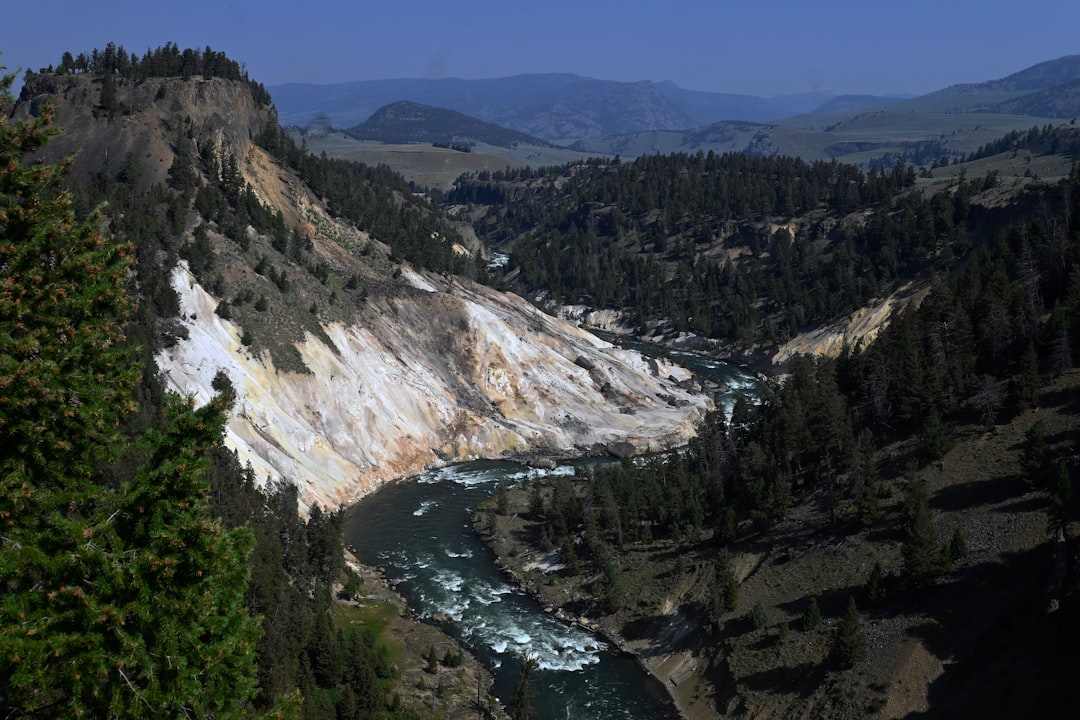
Revival of a Familiar Uplift Pattern (Image Credits: Unsplash)
Yellowstone National Park – Subtle ground uplift along the northern edge of the caldera has aligned with recent seismic swarms, highlighting the park’s dynamic subsurface processes.[1][2]
Revival of a Familiar Uplift Pattern
Scientists detected the onset of uplift in July 2025 just south of Norris Geyser Basin, on the north rim of Yellowstone Caldera. This motion mirrored a prolonged episode from 1996 to 2004, when the area rose by nearly 12 centimeters over several years. By late 2025, continuous GPS measurements recorded about 1.5 to 2 centimeters of rise, confirmed by satellite radar imagery spanning October 2024 to October 2025.[2]
Seismicity picked up notably from September through December 2025. A swarm exceeding 100 earthquakes struck directly above the uplift center in November, with the strongest reaching magnitude 2.7. Overall, 2025 saw only 1,113 located quakes across the region – below the typical annual range of 1,500 to 2,500. In January 2026, monitors tallied 100 more events at background levels.[3]
Historical Echoes in Seismicity and Shift
Past events offer context for the current interplay. In late December 2008, a swarm began beneath Stevenson Island in Yellowstone Lake and migrated northward over ten days. Ground at a nearby GPS station shifted 7 millimeters westward, signaling pressurized fluids – likely from the upper-crustal magma reservoir – moving through cracks opened by quaking rock.[1]
Another striking case unfolded from November 2013 into 2014 near Norris Geyser Basin. Uplift rates there topped 15 centimeters per year, among the swiftest recorded in Yellowstone. Seismicity surged alongside, peaking with a magnitude 4.8 quake on March 30, 2014 – the park’s largest since 1975. Deformation then flipped to rapid subsidence, tied to hydrothermal fluid buildup and release, possibly fed by deeper magmatic sources.[1]
Tools Tracking the Subsurface Dance
The Yellowstone Volcano Observatory employs a suite of instruments to capture these connections. Continuous GPS stations, such as NRWY near Norris and others spanning the caldera, measure millimeter-scale vertical and horizontal shifts. Interferometric synthetic aperture radar from satellites like Sentinel-1 maps broad deformation patterns.
- GPS data reveals uplift rates and extensions between stations.
- InSAR images pinpoint swarm locations atop rising ground.
- Seismic networks operated by the University of Utah locate quakes and detect swarms in real time.
- These tools confirmed the November 2025 swarm overlaying the uplift epicenter.
Such integration allows precise correlation, as seen in maps plotting 2025 quakes against 2025 deformation contours.[1]
Navigating Risks in a Volcanic Hotspot
Yellowstone’s caldera has subsided steadily at 2 to 3 centimeters annually since 2015, punctuated by seasonal fluctuations. The current north rim uplift remains minor compared to global caldera standards and shows no acceleration signaling hazard. “It is very unlikely to lead to any sort of volcanic eruption,” noted Yellowstone Volcano Observatory staff, as dramatic changes would precede such risks.[1]
Instead, these episodes reveal fluid or stress dynamics beneath the surface. While larger quakes or fluid releases remain possible, activity stays within normal bounds. Ongoing surveillance ensures timely updates for park visitors and nearby communities.
Key Takeaways
- Uplift since July 2025 totals 1.5–2 cm, echoing 1996–2004 patterns.
- November 2025 swarm of over 100 quakes aligned precisely with the rising zone.
- No eruption threat; changes reflect routine hydrothermal or magmatic stirrings.
Yellowstone’s ground and shakes remind us of its living geology, offering invaluable data on volcanic systems worldwide. What aspects of the park’s activity intrigue you most? Tell us in the comments.