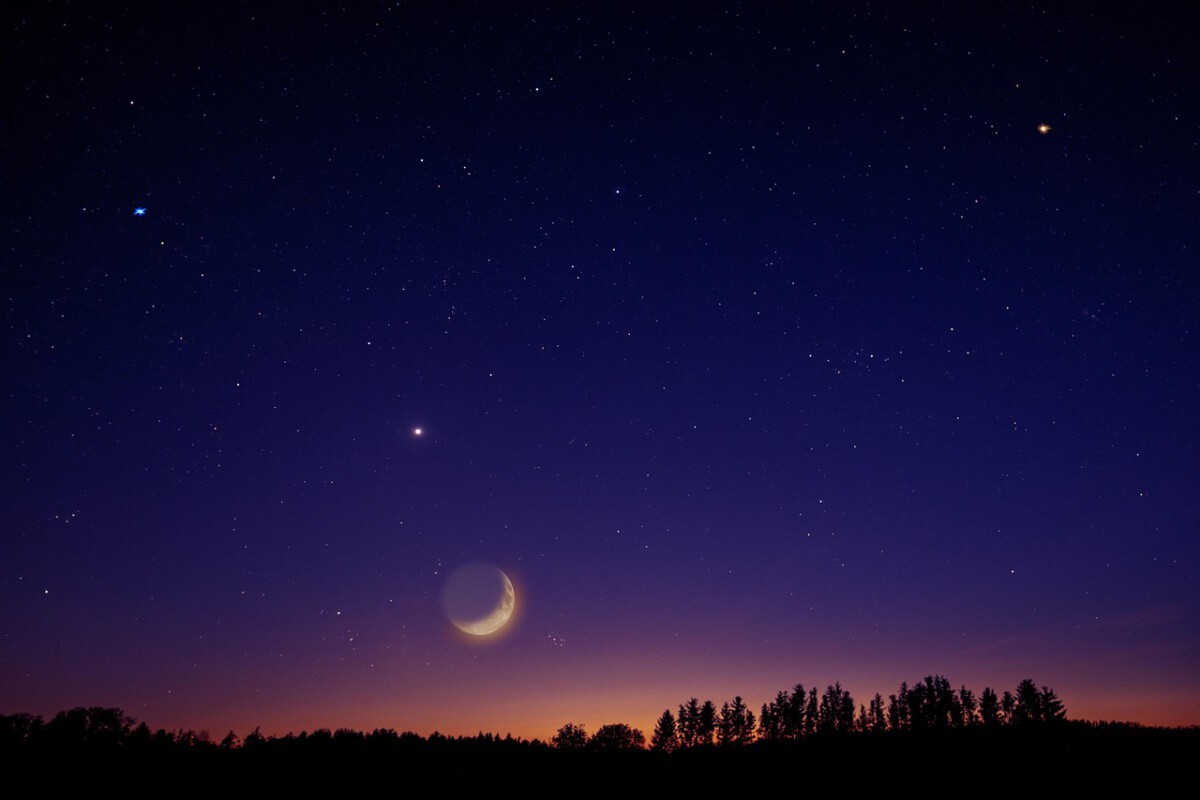
Venus Claims Its Place in Taurus (Image Credits: Pixabay)
Twilight on Saturday, April 18, 2026, brings a striking alignment low in the western sky for observers in the Northern Hemisphere. Brilliant Venus, having shifted into the constellation Taurus, appears alongside a thin waxing crescent Moon, with the famed Pleiades star cluster sparkling just above. This accessible display, visible to the naked eye shortly after sunset, highlights the dynamic motion of celestial bodies against the backdrop of spring constellations.[1][2]
Venus Claims Its Place in Taurus
Bright Venus stands out prominently one hour after sunset, reaching 11 degrees above the western horizon. The planet, known for its dazzling appearance as the evening star, has recently entered Taurus, adding to the constellation’s allure. Observers will notice its steady, untwinkling light contrasting with the stars around it.
This positioning occurs as the sky darkens, making Venus an ideal marker to locate other objects. At mid-northern latitudes, such as around 40 degrees north and 90 degrees west, sunset arrives around 7:42 p.m. local time, setting the stage for this view.[1] The planet remains visible until the Moon sets later in the evening.
The Waxing Crescent Moon Steals the Show
A delicate waxing crescent Moon, about 1.5 days old and illuminated to roughly 4 percent on its eastern limb by 10 p.m., positions itself approximately 6 degrees to the lower right of Venus. Earthshine softly glows across the rest of the lunar disk, rendering the entire Moon faintly visible against the deepening blue sky. Moonset occurs just before 10 p.m. local time, providing a narrow window for appreciation.
This phase follows closely after the New Moon, offering one of the slimmest crescents of the month. The Moon’s proximity to Venus creates a natural guidepost, drawing eyes upward to the broader scene. Such alignments remind viewers of the Moon’s swift orbital pace around Earth.[1]
Pleiades: The Seven Sisters Above
Situated about 7 degrees above Venus, the Pleiades star cluster – also called M45 or the Seven Sisters – adds a sparkling touch to the tableau. This young open cluster spans roughly 110 arcminutes across the sky, resembling a small dipper or spoon to the naked eye. Under darker skies, more than seven stars emerge, rewarding binocular users with intricate details.
Located in Taurus, the Pleiades serve as a seasonal marker for spring evenings. No telescope proves necessary; even a finder scope captures its wide-field beauty. Occasionally mistaken for the Little Dipper asterism farther north, this cluster stands out distinctly in the post-sunset glow.[1]
Prime Viewing Tips and Conditions
Head outdoors soon after sunset, facing west as the sky transitions from twilight to night. Clear horizons free of trees or buildings enhance the view, especially since the objects hug low altitudes. Binoculars reveal finer details in the Pleiades and the Moon’s earthshine, while the naked eye suffices for the basic trio.
Local times vary, but at 40° N latitude and 90° W longitude, expect sunrise at 6:17 a.m. and sunset at 7:42 p.m. The display peaks around one hour post-sunset, fading as the Moon sets near 10 p.m. Check weather for clear skies, as this event demands minimal light pollution.[1]
Here are essential steps for the best experience:
- Arrive 30 minutes after sunset to let your eyes adapt to darkness.
- Use Venus as your anchor – trace 6° down-right for the Moon and 7° up for Pleiades.
- Scan with binoculars for the cluster’s hazy glow and lunar subtleties.
- Photograph the scene with a tripod for sharp, wide-angle shots.
- Note the changing positions night to night as the Moon shifts eastward.
| Object | Position Relative to Venus | Altitude (1 Hour After Sunset) |
|---|---|---|
| Venus | Reference Point | 11° |
| Crescent Moon | 6° Lower Right | Lower |
| Pleiades (M45) | 7° Above | Higher |
Looking Back: Zodiacal Light from Yesterday
The previous evening, April 17, presented ideal conditions for the zodiacal light, a faint pyramid of sunlight scattered by interplanetary dust. Rising from the western horizon before dawn or after sunset, it complemented the emerging Venus-Moon pairing. Though primarily a night-before highlight, lingering twilight on April 18 might still yield glimpses under pristine skies.
This phenomenon underscores the week’s active sky calendar, including the approaching Lyrid meteor shower peak later in April. Such events layer wonder upon wonder for dedicated observers.[1][3]
This convergence of Venus, the Moon, and Pleiades encapsulates the accessible beauty of the night sky, inviting everyone to pause and gaze westward. It serves as a gentle reminder of the cosmos’s quiet rhythms amid daily life. For more details, visit Astronomy.com.[1]
- Venus at 11° altitude one hour after sunset, with Moon 6° lower right and Pleiades 7° above.
- Waxing crescent Moon shows 4% illumination and earthshine for a ghostly effect.
- No equipment needed – naked eye or binoculars maximize the free sky show tonight.
Step outside tonight and witness this celestial harmony. What catches your eye most in this lineup? Share your observations in the comments.