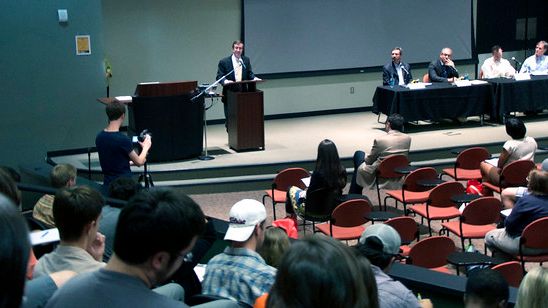
The Folly of Trump Taking a “Wrecking Ball” to a Crucial Science Advisory Board – Image for illustrative purposes only (Image credits: Flickr)
Scientists across the country reacted with dismay last week when the Trump administration dismissed all 22 members of the National Science Board, the independent overseer of a key federal research agency. This move stripped away a longstanding safeguard for unbiased scientific advice, leaving experts worried about the immediate fallout for funding decisions and long-term innovation. The action deepened concerns among researchers who already faced slashed budgets and facility closures since the president’s second term began in January 2025.
A Critical Loss for Scientific Oversight
The National Science Board holds a pivotal position in guiding the National Science Foundation, which funds vital work in fields like biology, engineering, computing, and environmental science. Established by Congress in 1950, the board consists of eminent experts appointed to staggered six-year terms, shielding it from short-term political shifts. Its members advise both the president and Congress on national priorities, ensuring research aligns with broad societal needs rather than fleeting agendas.
Former board member Geraldine Richmond, a chemistry professor at the University of Oregon, highlighted its enduring value. “This board is so important for being able to advise Congress as well as the president on issues that are so important to the country,” she said. Without this body, the foundation risks operating solely under White House direction, potentially sidelining diverse expertise.
Shockwaves Through the Research Community
The dismissals arrived via email on a Friday, with members’ profiles swiftly removed from the NSF website, now displaying only “pending new appointments.” Paleoecologist Jacquelyn Gill of the University of Maine described the news as “one of the darkest moments” in recent history. “It was incredibly chilling, and my stomach just dropped to my feet,” she recalled, underscoring the personal toll on those dedicated to advancing knowledge.
Senior climate scientist Carlos Javier Martinez, formerly with the NSF and now at the Union of Concerned Scientists, saw it as part of a pattern. “It’s a continuous onslaught of attacks on science,” he noted. Fears mounted that replacements would prioritize political allegiance over qualifications, eroding trust in public institutions and deterring the next generation of researchers.
White House Cites Legal Concerns, Drawing Skepticism
A White House official attributed the firings to a 2021 Supreme Court decision on administrative patent judges, claiming it questioned the board’s authority without Senate confirmation. The statement promised collaboration with Congress to revise the statute, insisting NSF operations would proceed normally. Yet legal experts dismissed this as unconvincing.
Lauren Kurtz, executive director of the Climate Science Legal Defense Fund, called the argument a “smoke screen.” She pointed out that NSB governing laws had been updated in 2022, rendering the cited ruling inapplicable. Martinez echoed this: “It doesn’t hold water.” Critics argued the rationale masked a broader intent to install loyalists, much like past administration moves.
Long-Term Risks to Innovation and Discovery
Beyond immediate control, the purge threatens the foundation’s commitment to curiosity-driven research – projects without instant commercial payoff but immense future potential. Gill lamented a shift toward industry demands, particularly from tech giants courting the administration. “Having a scientific enterprise that focuses primarily on the needs of industry just means that we’re losing curiosity-driven science,” she said.
Such a focus neglects critical areas like climate impacts, biodiversity, and pollution tracking, where private sectors show little interest. Historical examples abound: electricity was studied for centuries before practical uses emerged. Observers warned of diminished U.S. competitiveness, a shrinking talent pipeline, and missed breakthroughs in decades ahead.
Key Concerns Raised by Experts:
- Replacement of qualified scientists with politically aligned figures.
- Loss of independent advice to Congress and the president.
- Shift from exploratory research to industry-favored projects.
- Erosion of public trust and talent retention in science.
The board’s absence leaves a void in accountability, amplifying risks from ongoing budget cuts and grant cancellations. As the administration eyes new appointees, the research community braces for uncertain reconstruction. For scientists like Gill, the deeper worry lies in what unexplored paths this decision might close off forever, reshaping America’s innovative edge in profound, lasting ways.