How a “super El Niño” could create record-breaking warming – Image for illustrative purposes only (Image credits: upload.wikimedia.org)
Scientists monitoring the Pacific Ocean have issued warnings about a brewing strong El Niño that could propel global temperatures beyond the critical 1.5 degrees Celsius threshold above pre-industrial levels. This warm phase of a natural ocean-atmosphere cycle might not only spike heat in the coming year but also lock in higher averages long-term amid ongoing greenhouse gas emissions. Such an event would mark a pivotal shift, amplifying risks already evident in record-hot 2024.
The Mechanics of a Climate Amplifier
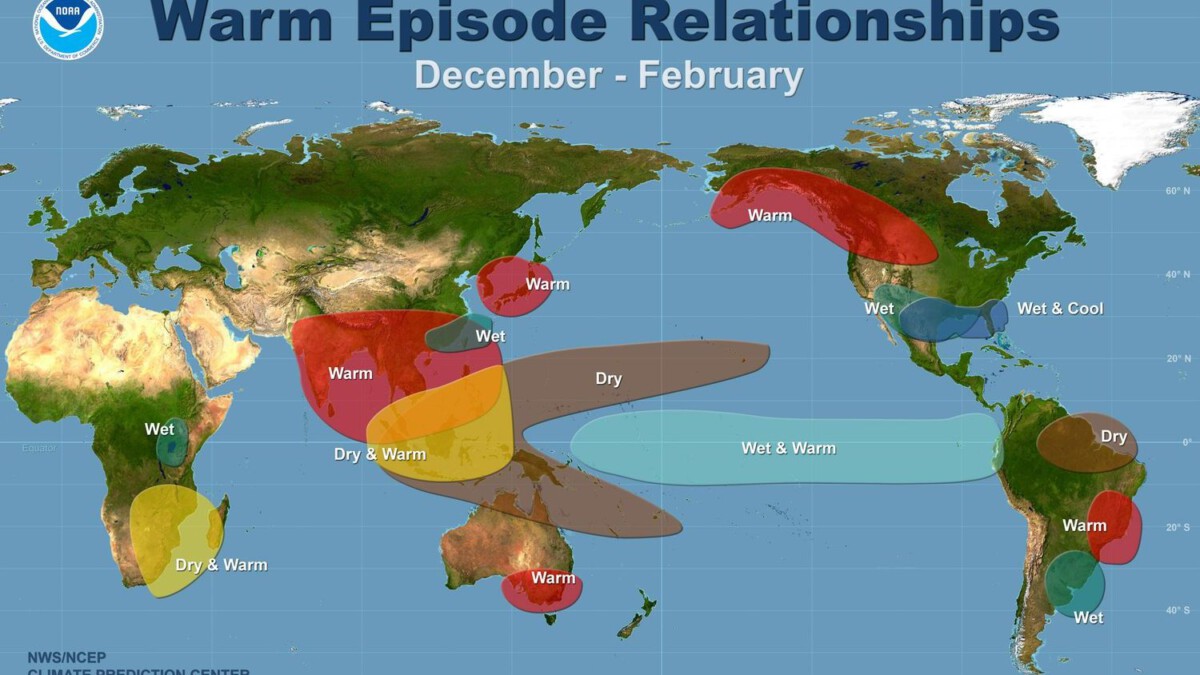
El Niño emerges when trade winds weaken, allowing vast reservoirs of heat in the western Pacific to flow eastward across the equator. This Warm Pool, spanning an area four times the size of the continental United States, represents Earth’s hottest ocean waters. The resulting surge releases pent-up energy into the atmosphere, reshaping weather from storms to droughts worldwide.
Projections indicate this cycle could intensify within the next 12 to 18 months. Climate scientist James Hansen noted that even a moderately strong El Niño might elevate annual global averages to about 1.7 degrees Celsius above pre-industrial baselines. He expressed skepticism that temperatures would retreat below 1.5 degrees Celsius once crossed, given persistent human-driven warming.
From Weather Event to Regime Shift
A recent study highlighted how “super El Niños” – defined by sea surface temperatures exceeding two standard deviations above normal – trigger lasting changes rather than fleeting disruptions. Published in December 2025 in Nature Communications, the research analyzed events from 1982-83, 1997-98, and 2015-16. These episodes sparked marine heatwaves, coral bleaching, and mass die-offs of marine life, with effects lingering for years.
Co-author Jong-Seong Kug, a climate researcher at Seoul National University, described these as climate shocks pushing sensitive systems into new states. Over land, they altered soil moisture and precipitation, fostering prolonged droughts or floods. Kug emphasized that such shifts extend risks beyond single seasons, affecting food production and water security repeatedly.
Hotspots Vulnerable to Lasting Change
Oceanic regime-shift zones include the central North Pacific, southeastern Indian Ocean, southwestern Pacific, and Gulf of Mexico. These areas, connected through atmospheric teleconnections, experienced persistent anomalies post-super El Niño. Coral reefs suffered irreversible damage, while fisheries collapsed due to ecosystem disruptions.
On land, signals appeared in East Africa, the Maritime Continent around Indonesia, central southern Asia, central Australia, the Amazon, and western Greenland. Soil moisture deficits in these regions linked to reshaped rain and heat patterns, heightening vulnerability. The study revealed how global warming exacerbates these dynamics, creating a feedback loop that primes the climate for more abrupt transitions.
- Central North Pacific: Prolonged marine heatwaves
- Maritime Continent: Altered precipitation regimes
- Amazon Basin: Extended drought risks
- Gulf of Mexico: Ecosystem perturbations
Adapting to an Unstable Future
Societies built on predictable climates now face volatile swings between extremes. Reservoirs fluctuate wildly, crops mismatch seasons, and urban heat claims lives. The United Nations Environment Programme’s 2025 Adaptation Gap Report underscored the shortfall: developing nations require $310 billion to $365 billion annually by 2035, yet funding lags far behind.
Experts urge a shift from reactive measures to transformative strategies, redesigning infrastructure for unprecedented conditions. Kug warned that super El Niños do not deliver isolated extremes but redefine baseline climates. Closing the adaptation gap demands anticipating these compounded threats, as the old normal recedes further.
As the Pacific simmers, the world stands at a crossroads. A super El Niño could crumble the fragile edge of stability, compelling urgent action to mitigate what nature and emissions have already set in motion.