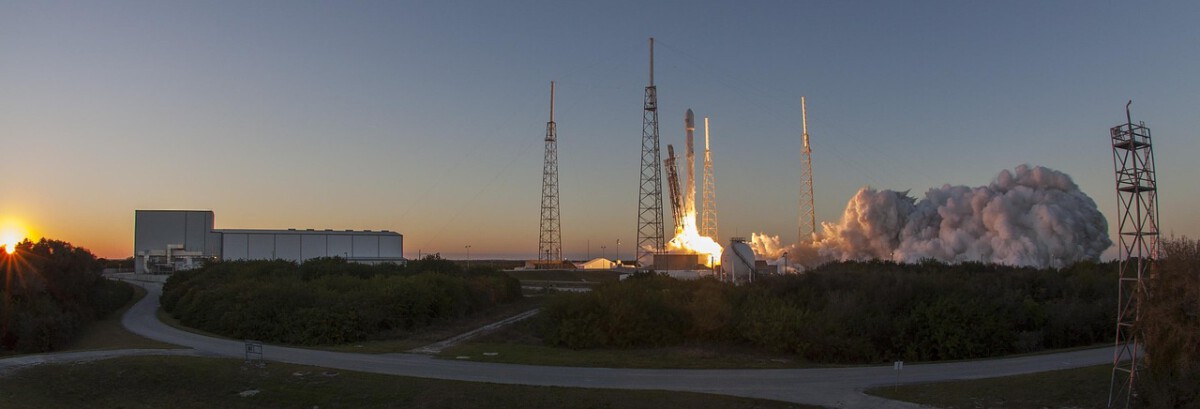
Space Cooling’s Brutal Reality (Image Credits: Pixabay)
Elon Musk positioned SpaceX for what could become the biggest initial public offering ever, targeting a valuation between $1.75 trillion and $2 trillion. Central to this ambition lies a bold proposal: deploying 1 million AI servers into orbit to form a 100-gigawatt data center within the next decade. The plan also envisions a lunar factory to propel these servers toward Earth orbit. Yet physicists, engineers, and chip designers argue that fundamental barriers in physics and logistics render the timeline unrealistic.
Space Cooling’s Brutal Reality
A single modern telecom satellite dissipates about 20 kilowatts of heat, manageable through its own body acting as a passive radiator. Musk’s vision scales this to 100 gigawatts across 1 million satellites, meaning each must handle 100 kilowatts continuously. Such power levels demand enormous deployable radiators on every craft, along with intricate zero-gravity plumbing to shuttle heat via pressurized fluids.
Harvard astrophysicist Avi Loeb highlighted refrigeration woes in space, where gravity-dependent systems falter and oil can clog compressors without it to settle. “Heat cannot rise away from components through natural convection,” Loeb noted in an email. Engineer Damien Dumestier, who studied orbital data centers, emphasized the inefficiency of radiation-only cooling in the near-absolute zero of space. NASA engineer Ryan McClelland summed it up: “Cooling things in space is well understood. It is the scale required that is mind-boggling.”
Power Generation and Chip Overhaul Required
Solar panels would fuel these servers, but capturing 100 gigawatts demands over 1 billion square feet of panels – equivalent to 32.8-foot arrays per satellite. Loeb likened the setup to a “miniature version of a Dyson sphere,” the star-encircling megastructure theorized by Freeman Dyson. Current satellites already show radiators dwarfed by solar arrays, and the power-to-heat ratio hits roughly 4.5 to 1, per Dumestier’s estimates.
Standard chips won’t survive; new designs integrating Peltier coolers and photonic circuits are needed, technologies still experimental or nascent. An anonymous chip industry expert stressed reimagining silicon for space, including heterogeneous compute to manage heat. Even SpaceX’s new Terafab chip factory with Tesla raises questions about readiness for such extremes. Small-scale orbital data centers might emerge in 10 years, the expert conceded, but Musk’s full vision stretches further.
Orbital Clutter and Lunar Pipe Dreams
Crowding low Earth orbit with 1 million large satellites risks the Kessler syndrome, a debris cascade from collisions. Loeb warned of catastrophic chain reactions, echoing recent incidents like debris cracking a Chinese spacecraft window in 2025. The FAA projected potential casualties from falling debris by 2035. Europe’s ASCEND study suggested just 1,000 higher-altitude satellites for 100 megawatts – far shy of Musk’s gigawatt-scale goal.
Musk’s lunar factory and electromagnetic launcher aim to cut launch costs, but Loeb called it “speculative science fantasy,” likely decades away. Olivier Hainaut of the European Southern Observatory praised SpaceX’s rapid iterations but predicted delays beyond claims. SpaceX engineers control the stack effectively, yet unproven tech like mass drivers adds uncertainty.
Revenue Engines Face Mounting Threats
SpaceX relies on Falcon 9 launches, boasting up to 77% profit margins, and Starlink’s 9 million users for cash flow. Chinese firms like CAS Space already priced launches at $1,970 per pound versus SpaceX’s $3,100, with reusability tests underway to halve costs further.CAS Space details Rocket Lab and Blue Origin erode the monopoly domestically.
Starlink’s cellular push contends with rivals like AST SpaceMobile, which needs only 90 satellites using wall-penetrating spectrum for standard phones. SpaceX’s 34,000 V3 satellites demand Starship, still unproven, risking bankruptcy without it, Musk admitted. Astrophysicist Scott Manley noted thermal nightmares at scale.Manley analysis
Key Takeaways
- Orbital cooling demands massive radiators and new plumbing, unfeasible at gigawatt scale soon.
- Solar power needs vast arrays; chips require space-hardened innovations decades out.
- Low orbit risks Kessler syndrome; lunar factories remain unproven fantasies.
- Falcon 9 and Starlink face cheaper rockets and superior cellular competitors.
SpaceX has defied odds before, revolutionizing reusability amid near-collapse. Still, experts foresee decades for Musk’s orbital empire, not years, amid eroding earthly advantages. Investors betting on lunar visions might overlook terrestrial cracks. What risks do you see in SpaceX’s grand plan? Share in the comments.