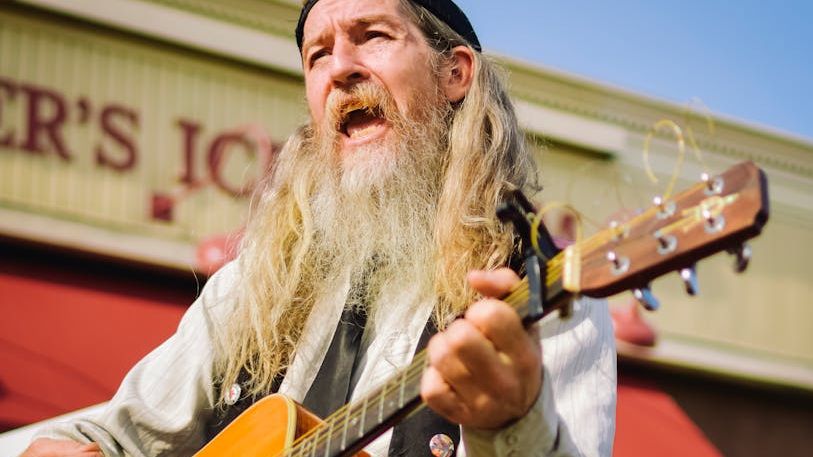
A Life Forged in Reform Schools and Prison Yards (Image Credits: Pexels)
David Allan Coe, whose raw voice and rebellious spirit helped define outlaw country in the 1970s, passed away on April 29, 2026, at the age of 86.[1][2] He died in intensive care around 5 p.m. Eastern Time following years of declining health.[3] His widow, Kimberly Coe, confirmed the news to Rolling Stone, remembering him as one of the best singers, songwriters, and performers of the era.[4]
A Life Forged in Reform Schools and Prison Yards
Born on September 6, 1939, in Akron, Ohio, Coe faced a troubled youth that landed him in reform schools as early as age nine.[2] He spent much of the next two decades in correctional facilities, including three years at the Ohio Penitentiary. Those experiences shaped his songwriting, which often drew from themes of hardship and defiance.
Released in 1967, Coe moved to Nashville, where he busked on the streets and honed a blues-inflected style before pivoting to country.[2] He signed with Plantation Records and released his debut album, Penitentiary Blues, in 1970. Though mainstream success eluded him at first, his gritty tales resonated with a growing audience tired of polished Nashville sounds.
Embracing the Outlaw Mantle
Coe emerged as a central figure in the outlaw country movement alongside Waylon Jennings and Willie Nelson, rejecting Music Row’s conventions with long hair, biker gear, and rhinestone suits.[2] His signing with Columbia Records in the mid-1970s marked a turning point. Albums like The Mysterious Rhinestone Cowboy (1974) and Once Upon a Rhyme (1975) captured his larger-than-life persona.
He cultivated a mythic image, arriving at shows in a hearse or wearing a Lone Ranger mask, and even staged fake performances outside Nashville’s Ryman Auditorium.[5] Waylon Jennings once called him “the most sincere of the bunch” amid the genre’s bandwagon riders, though their relationship had its tensions.[2] Coe’s affiliation with the Outlaws Motorcycle Club further cemented his renegade status.
Anthems That Echo Through Country History
Coe’s songwriting prowess shone brightest when penning hits for others. He crafted “Would You Lay with Me (In a Field of Stone),” a No. 1 for Tanya Tucker in 1973, and “Take This Job and Shove It,” which topped the charts for Johnny Paycheck in 1977 and inspired a film.[1] As a performer, he notched his own successes, including the self-aware novelty “You Never Even Called Me by My Name,” which reached No. 8 on the country charts in 1975.[2]
- “Longhaired Redneck” from his 1976 album of the same name
- “The Ride” (1983), a Top 10 hit imagining a ghostly encounter with Hank Williams
- “Mona Lisa Lost Her Smile” (1984), peaking at No. 2 on Billboard
Over four decades, Coe released more than 40 studio albums and maintained a loyal following at motorcycle rallies and honky-tonks into his later years.[1] Collaborations with artists like Kid Rock, Pantera’s Dimebag Darrell, Hank Williams III, and Hardy extended his influence across genres.[2]
Navigating Scandals and Personal Struggles
No stranger to controversy, Coe drew fire for his underground “X-rated” albums, Nothing Sacred (1978) and Underground Album (1982), which featured racial slurs and explicit content he described as parody.[5] He rejected accusations of racism, pointing to his prison friendships and dreadlocked appearance, but the material alienated parts of his audience.
Financial woes led to a 2015 guilty plea for tax evasion, resulting in three years’ probation and nearly $1 million in back taxes.[2] Health challenges mounted in recent years, including a battle with COVID-19 at age 82. He leaves behind his sixth wife, Kimberly Hastings, and several children.[1]
“David was a Country Music treasure and loved his fans. Most importantly, he was a true outlaw and a great singer, songwriter, and performer.”
– Statement from Coe’s representative to PEOPLE
A Rebel’s Lasting Mark on Music
Coe’s death closes a chapter on one of country music’s most polarizing figures. His unfiltered anthems captured the frustrations of working-class listeners and challenged the genre’s boundaries. While his provocations sparked debate, his contributions to outlaw country endure.
Kimberly Coe captured the sentiment shared by many fans: “My husband, my friend, my confidant and my life for many years. I’ll never forget him and I don’t want anyone else to ever forget him either.”[4] In an industry that often favors conformity, David Allan Coe rode his own path to the end.