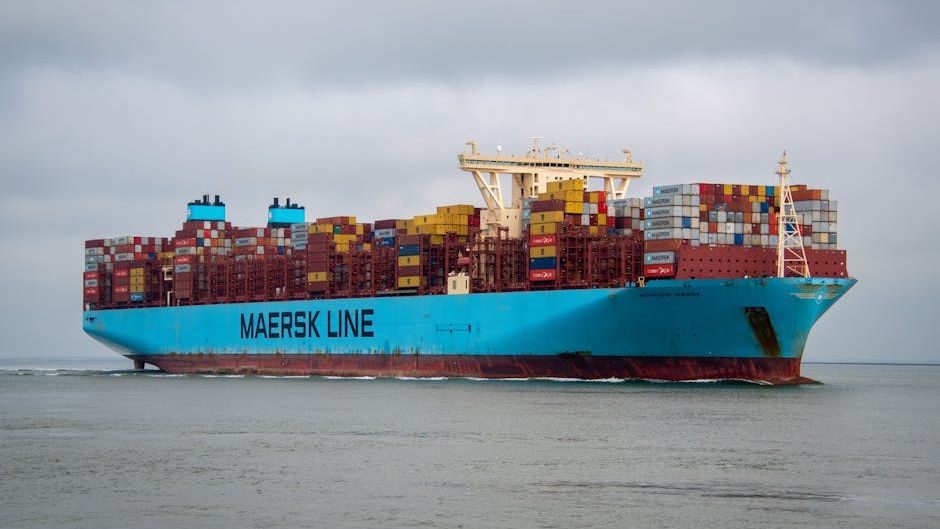
Maersk first-quarter profit beats forecasts, keeps outlook unchanged – Image for illustrative purposes only (Image credits: Pexels)
Copenhagen – A.P. Moller-Maersk delivered first-quarter earnings that exceeded analyst expectations, buoyed by robust container volumes even as freight rates softened amid industry overcapacity.[1][2] The shipping conglomerate posted an underlying EBIT of $340 million, down sharply from the prior year but ahead of consensus estimates. Company executives highlighted resilient demand from Asian exports and operational efficiencies as key factors supporting the performance. Guidance for the full year remains unchanged, signaling confidence in navigating ongoing market headwinds.
Profit Figures Beat Expectations Despite Year-on-Year Drop
Maersk recorded revenue of $13.0 billion for the quarter ended March 31, a 2.6% decline from $13.3 billion in the first quarter of 2025.[3] EBITDA came in at $1.8 billion, surpassing Visible Alpha consensus of $1.66 billion, while EBIT totaled $340 million.[4][5] Net profit stood at $100 million, with the group’s share at $53 million, reflecting underlying profit of $171 million.
These results marked a significant year-over-year decrease – EBIT fell 73% from $1.25 billion – but volumes rose across segments, offsetting lower rates. Free cash flow turned negative at $874 million, compared to a positive $806 million last year, due to higher capital expenditures. The performance underscored Maersk’s ability to capture market share in a normalizing freight environment.
Ocean Division Faces Headwinds, Offset by Volume Gains
The Ocean segment, Maersk’s core business, reported revenue of $8.2 billion, down 8.2% from the previous year.[2] EBIT swung to a loss of $192 million from a $743 million profit, as loaded freight rates dropped 14% to $2,081 per FFE amid vessel overcapacity. Volumes, however, climbed 9.3% to 3.2 million FFE, fueled by strong Asian export demand outpacing fleet growth.
Operational costs remained stable, with unit costs at fixed energy prices falling 7% year-on-year to $2,304 per FFE, aided by the Gemini network cooperation. Bunker expenses decreased 15%, and consumption improved 5.3%. The segment achieved 96% utilization, demonstrating effective capacity management despite disruptions.
Terminals and Logistics Drive Profit Growth
Maersk’s Terminals division shone, with revenue up 6.7% to $1.3 billion and EBIT rising 11% to $436 million.[3] Moves increased 4.3% year-on-year, while revenue per move grew 3.4% due to higher rates and favorable mix. The unit maintained a robust EBIT margin of 33.2%, up from 32%.
Logistics & Services also advanced, posting revenue growth of 8.7% to $3.8 billion and EBIT up 22% to $173 million. Margin expansion to 4.6% reflected gains in air freight and middle-mile services, alongside expansions like a new automated center in Singapore. These diversified operations provided a buffer against Ocean volatility.
| Key Metrics | Q1 2026 | Q1 2025 | YoY Change |
|---|---|---|---|
| Revenue ($B) | 13.0 | 13.3 | -2.6% |
| EBITDA ($B) | 1.8 | 2.7 | -35% |
| EBIT ($M) | 340 | 1,253 | -73% |
| Ocean Volumes (k FFE) | 3,203 | 2,929 | +9.3% |
Geopolitical Tensions Add Uncertainty
Middle East conflict, escalating from late February 2026, exerted limited financial pressure in the quarter due to timing. Operations faced disruptions, including suspended Strait of Hormuz transits and six vessels stuck, but spot rates and surcharges mitigated costs. Schedule reliability suffered, yet no material earnings impact materialized.
Broader market dynamics included persistent Red Sea rerouting normalization and new vessel deliveries exacerbating overcapacity. Maersk noted robust demand in Africa and Europe but flagged macroeconomic downside risks. Fuel efficiency measures and slow-steaming options remained under review.
Steady Outlook Amid Challenging Landscape
Maersk reaffirmed its full-year 2026 guidance: underlying EBITDA of $4.5 billion to $7 billion, EBIT from -$1.5 billion to $1 billion, and free cash flow above -$3 billion.[1] Capital expenditures for 2026-2027 are projected at $10-11 billion. Global container volume growth is expected at 2-4%, with Maersk aiming to match the market.
The company emphasized strategic priorities like fleet renewal – 33 dual-fuel vessels ordered – and low-emission fuels, including LNG from 2027 and ethanol trials. Executives stressed partnerships with customers and cost discipline as pillars for resilience. As trade routes stabilize and capacities adjust, Maersk positions itself for measured recovery in a volatile global economy.Maersk Investor Relations